







The Fatigue Has a Name: The Mitochondrial Distress Hormones GDF15 and FGF21
Science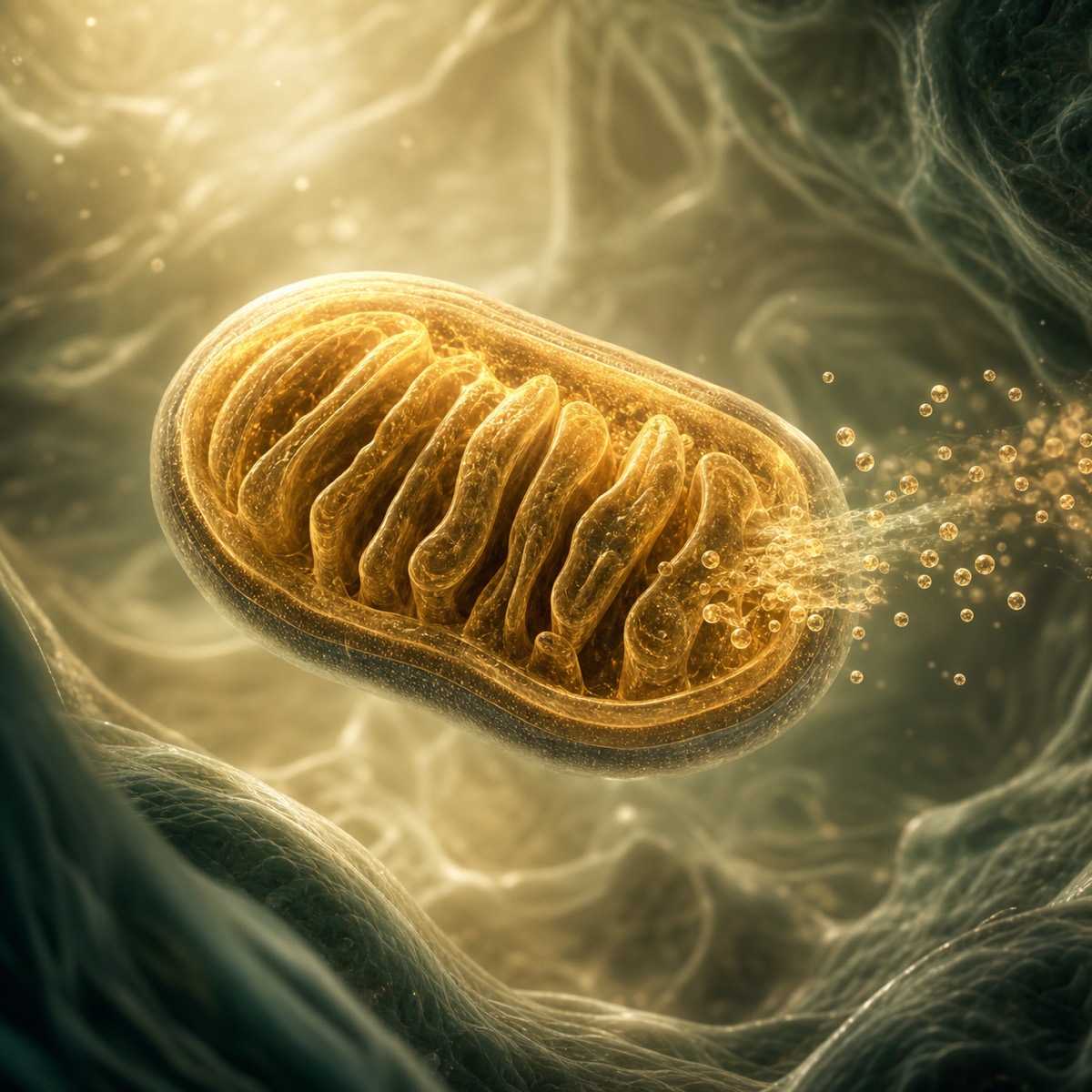
The most dismissed symptom of mold illness is fatigue. Patients hear "you're just tired," "you're deconditioned," "it's probably depression." But the fatigue of this illness isn't the simple absence of energy, and it isn't a character flaw. It's an active biological signal — one your mitochondria broadcast into the bloodstream on purpose. And it has chemical names: GDF15 and FGF21.
Mitochondria talk to the whole body
We're taught that mitochondria are the cell's batteries. They're also its threat sensors — and its messengers. When mitochondria come under sustained stress, they switch on an internal program called the integrated stress response. That program does two things worth knowing. First, it throttles the cell's protein-building, dialing down construction to conserve resources. Second, it releases two hormones into the blood: GDF15 and FGF21. Because they're sent *from* the mitochondria *to* the rest of the body, they're called mitokines — mitochondrial messages.
What the message says
The message is, roughly: we're rationing. GDF15 and FGF21 are signals of metabolic stress and conservation — the molecular version of a body pulling back from spending energy it doesn't have. This is the same family of "sickness behavior" you feel during a bad flu: the pull to rest, the loss of appetite, the sense that even small efforts cost too much. It is ancient, protective, and entirely real.
So the exhaustion isn't imaginary and it isn't laziness. It's a conservation program running exactly as designed — just stuck on, long after the original threat.
Why it feels exactly like the flu
There's a reason "I feel like I'm coming down with something" is such a common way to describe a bad day — followed by never actually coming down with anything. The sickness behavior of a real infection — the malaise, the appetite loss, the retreat to bed, the aversion to light and noise — is itself an orchestrated program, driven in part by these same mitochondrial stress signals acting on the brain. In an acute infection it runs for a few days and resolves. In mold illness it's running off a stuck alarm, so it never switches off. You get the flu-that-never-arrives, on repeat.
It also makes sense of some of the stranger downstream symptoms — the flattened appetite, the fraught relationship with food and weight, the way both effort and eating can feel like more than the body can afford. These aren't separate problems to chase one by one. They're facets of a single rationing state, broadcast by a single set of signals.
Fatigue in mold illness isn't the absence of energy. It's a signal your mitochondria are broadcasting — measurable, real, and on purpose. — Andrew Heyman, MD
Why "your labs are normal" misses it
Ordinary blood work doesn't measure any of this, which is a big part of why patients get waved off. Worse, one of the more sophisticated tools — gene-expression (transcriptomic) panels that count a cell's mRNA — can actually point the wrong way. Under this stress response, the cell slams on a brake at the *translation* step, the point where genetic instructions become working proteins. A gene panel counting mRNA can't see that brake: the transcripts may look unchanged or even elevated while the cell's real functional output is falling.
This is where GDF15 and FGF21 earn their keep. They're measurable in a blood draw, and they index something a gene panel can't: that the mitochondrial stress response is actually engaged. They confirm the alarm is on. (They don't tell you how much reserve is left — for that, you measure a cell's respiration directly — but that's a story for another article.)
Why this matters for you
Naming the mechanism changes two things. It validates what you already know — that the fatigue is physical, not a mood or a weakness — and it points at the real fix. If exhaustion is a rationing signal from stressed mitochondria, the answer is never "push through." It's to lower the load that keeps the stress response switched on and to rebuild the mitochondrial machinery, so the distress hormones can finally power down. Your fatigue isn't a mystery or a personal failing. It's a signal — and signals can be turned off at the source.