





Visual Contrast Sensitivity: What a Screen Test Can — and Can’t — Tell You
Testing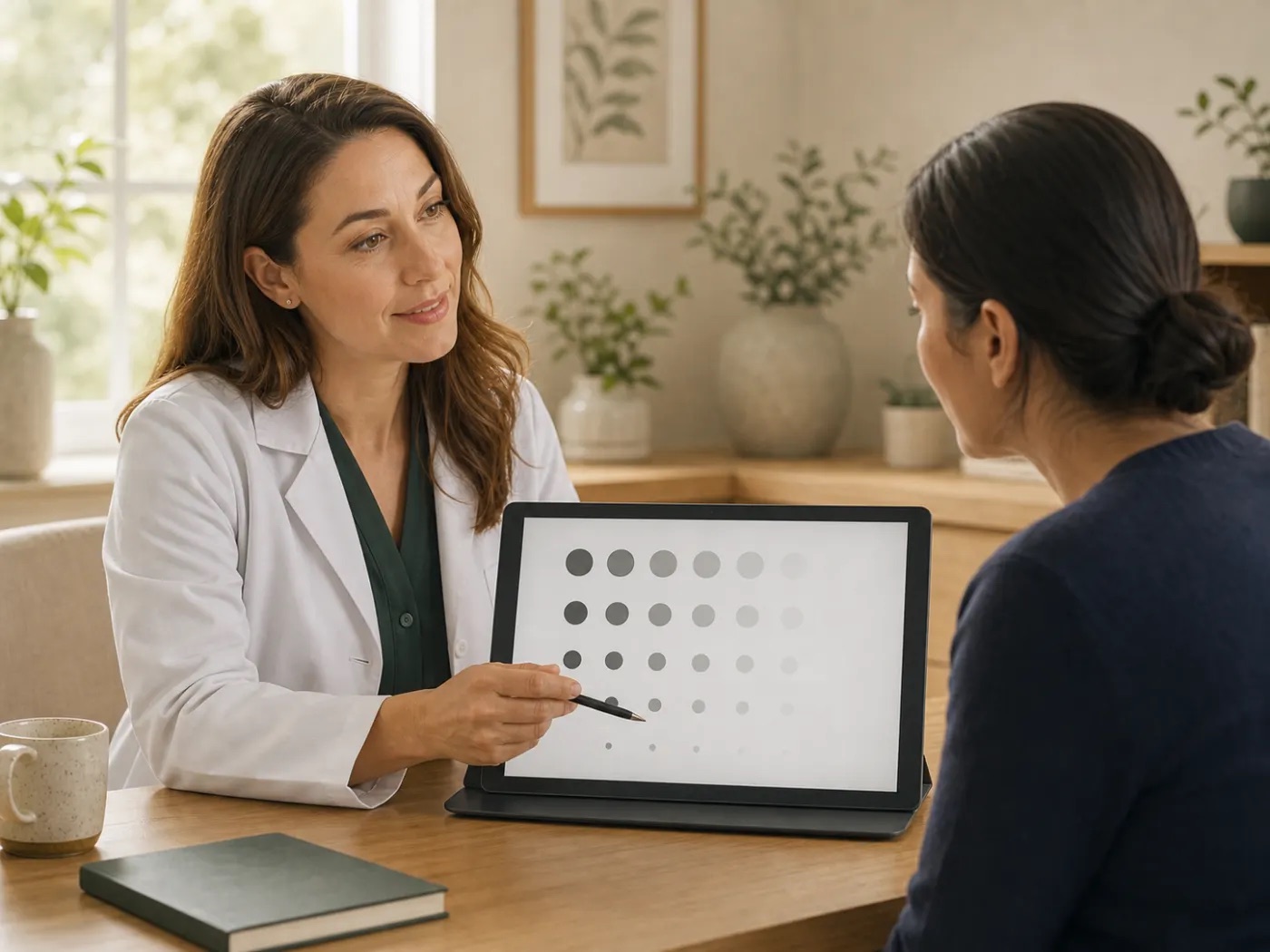
The visual contrast sensitivity test — where you pick out faint gray stripes — is a fixture of mold screening. It is genuinely useful, and it is genuinely easy to misunderstand. Here is the honest version of what it can and cannot do.
What it measures
It measures your ability to distinguish subtle contrast, a job done by large, energy-hungry neurons in the visual system. Those neurons are among the first to falter when biotoxin-driven neuroinflammation sets in — and among the first to recover. That is why a standard eye exam can be perfect while this test catches something: they measure different things.
Sensitive, but not specific
The same feature that makes it valuable is its limitation.
Its great strength, sensitivity, is inseparable from its great weakness, non-specificity. — Andrew Heyman, MD
A failed test flags neuro-inflammation worth investigating — but Lyme disease, heavy metals, and other conditions can impair it too. It points; it does not diagnose. A pass is reassuring; a fail is a reason to look closer, not a verdict.
The engineering problem with digital versions
Done properly — on a calibrated, high-bit-depth display at a controlled distance — it is a real instrument. Served as a generic web test to whatever screen and lighting you happen to have, it becomes an easy-to-corrupt novelty. Calibration is not a formality; it is the difference between a measurement and a guess. (It is exactly why a proper screen walks you through display and distance calibration first.)
The takeaway
Use the test for what it is good at: a quick, repeatable check of neuro-inflammatory reserve that can even track recovery within days of leaving an exposure. Just do not ask a contrast test to name the cause — that is the job of the workup that follows.