





Why You Feel Far Sicker Than Your Lab Results Look
Science
One of the loneliest experiences in mold illness is this: you feel profoundly, undeniably sick — bone-deep fatigue, nausea, a body that has quit — and your standard labs come back “basically normal.” That mismatch is used to dismiss patients. It should not be. There is now a molecular explanation, and it runs through your brainstem.
Your cells have a broadcast system
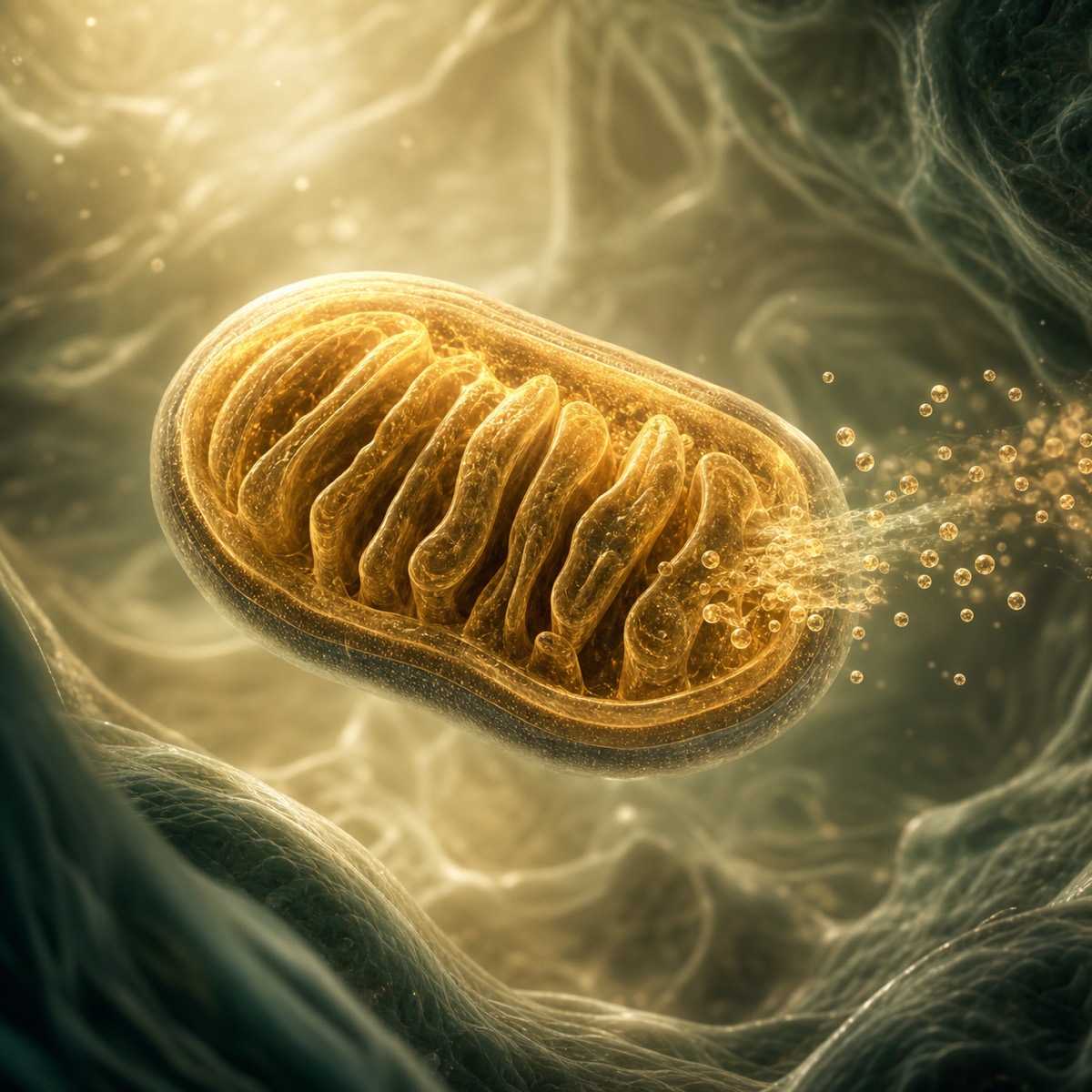
When mitochondria are under sustained stress, they do not suffer silently. They release signaling hormones — chiefly GDF15 and FGF21 — into the blood. These are the cell’s way of announcing, body-wide, that something is wrong.
A hormone the brain reads as “we are poisoned”
GDF15 acts on a receptor found in one very specific place: the part of the brainstem that generates nausea, appetite loss, and sickness behavior — the same machinery that makes you feel wretched during an infection or in early pregnancy. While GDF15 stays high, that “sick” signal stays on.
A mitochondrial stress loop in the periphery broadcasts a hormone that the brainstem reads as “we are poisoned,” producing sickness behavior without any structural lesion and without any requirement for antigen presentation. — Andrew Heyman, MD
Read that again: no structural lesion. Nothing for a routine scan or panel to catch. The suffering is real and the cause is real — it is a signal, not a lesion, which is precisely why the usual tests miss it.
These markers move — which is the point
Unlike a fixed gene or a vague label, GDF15 and FGF21 rise with your burden and fall as you recover. They can be measured. That turns “you feel sick but we can’t find anything” into “here is the signal, and here it is coming back down.”
A susceptibility marker that moves with treatment is the signature of an acquired, modifiable state. — Andrew Heyman, MD
What to do with this
If your ordinary labs look normal but you know you are unwell, the answer is not to try harder to feel fine. It is to measure the right things — the mitochondrial stress signals that track how your cells are actually doing — and to lower the load keeping them high. Your experience is data. The biology is finally catching up to it.