




Flat Is the Illness: Why Recovery Means Getting Your Rhythms Back
Recovery
Most of us picture recovery as climbing back to a number: enough energy, enough sleep, lab values that finally read "normal." But the chronobiology of the Cell Danger Response points at something stranger and more hopeful. Health isn't really a level you reach. It's a rhythm you keep. And in that light, being chronically ill is best described in one word: flat.
A healthy body is built to swing
Look closely at any healthy system and you'll find it oscillating. Cortisol rises steeply in the morning and falls to almost nothing at night. Core body temperature climbs and dips across the day. Heart rate variability — the tiny beat-to-beat differences in your pulse — expands and contracts. Even inside a single cell, chemistry runs in daily redox cycles. Health lives in the *swing*: the amplitude (how big), the slope (how sharply it turns), and the variability (how freely it moves).
A body with strong daily rhythms is a resilient body. It can rise to a demand and settle back down. The rhythm itself is the resilience.
A stuck alarm is a flat line
When the Cell Danger Response gets stuck, it doesn't just stay "too high." Read chronobiologically, stuck means arrhythmic. The system collapses into a flat, defensive set-point: a blunted cortisol curve that barely rises in the morning, heart rate variability that stays low all day, a temperature that no longer moves, sleep that never deepens. The medical word for what's lost is dynamic range.
This is why so many people with mold illness are told their averages look fine and still feel terrible. Average cortisol, average heart rate, average temperature can all sit in range while the *rhythm* that's supposed to carry them is gone. The number is fine. The music has stopped.
Health, at every scale, is oscillation. The stuck alarm is the collapse of that oscillation into a flat line — and recovery is the return of the swing. — Andrew Heyman, MD
The brain is the conductor
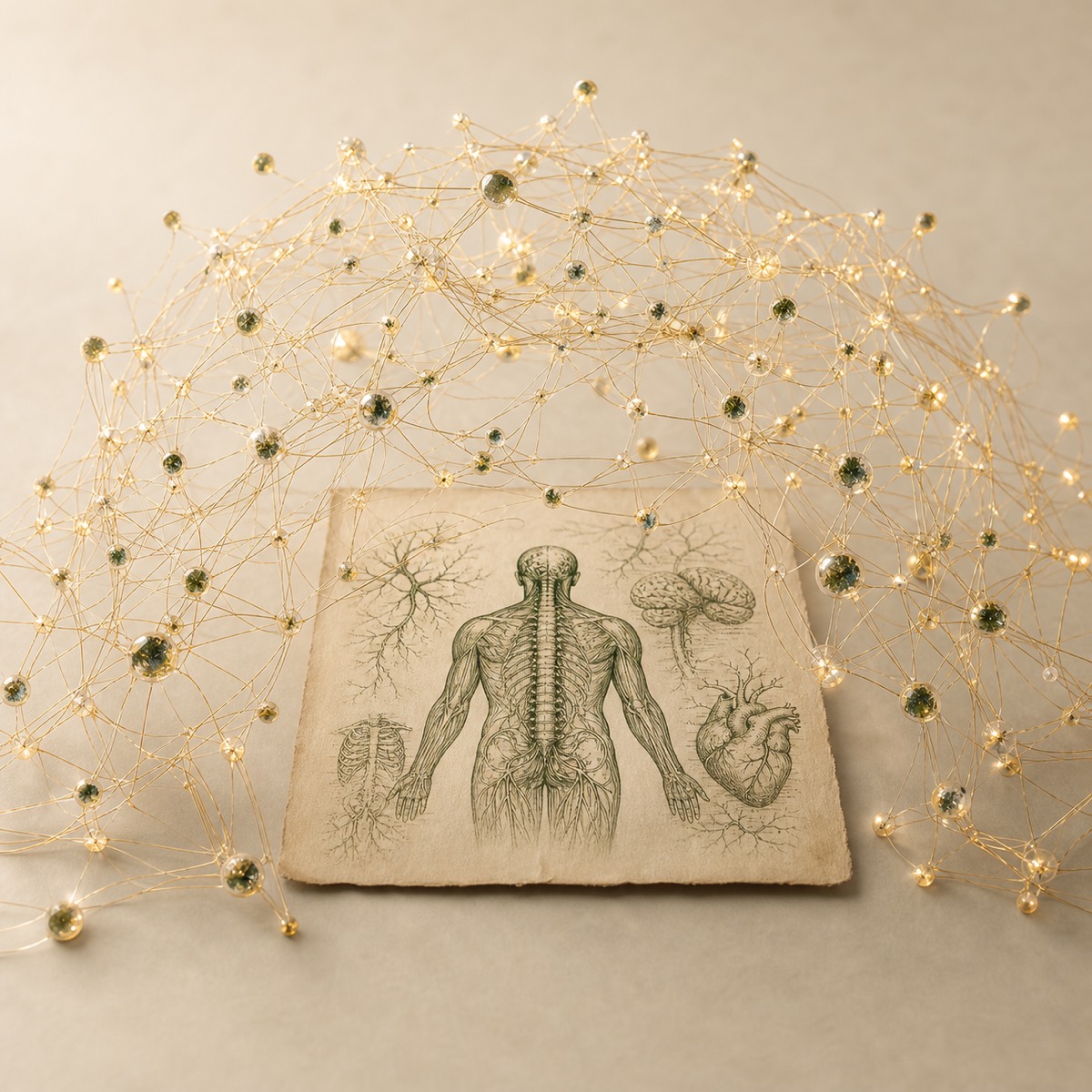
These rhythms don't keep themselves. They're broadcast from the brain — the suprachiasmatic nucleus (your master clock), the hypothalamus, and the autonomic pulse generators that set the beat for the rest of the body. When the danger response is stuck, the conductor loses the downbeat and the orchestra drifts out of sync: the gut clock, the adrenal clock, the sleep clock all start playing in different times.
That's the reason recovery has to run *through* the brain and nervous system, not around them. You can't supplement your way to a rhythm; you have to re-teach the conductor the beat.
What flat feels like from the inside
You don't experience a blunted cortisol curve as a graph. You experience it as a day with no shape. Mornings that should launch you feel like wading through wet sand — the "wired and tired" state where you're exhausted but can't get going. An afternoon crash that flattens you around three o'clock. Then, cruelly, a second wind at night, just when you should be winding down — because the peak that belonged to dawn is limping in hours late. And sleep you technically get but that never seems to *restore* anything.
Each of those is the same story told in a different organ: a rhythm that has lost its amplitude. The fix isn't a stimulant at breakfast and a sedative at bedtime to force the peaks and troughs by brute chemistry. It's re-teaching the body when to make its own.
You can watch the rhythm come back
One quietly encouraging thing about this framing is that rhythm is measurable, so recovery becomes visible before you fully feel it. A morning-to-night cortisol curve regaining its steep early rise. Heart rate variability — trackable on many wearables — climbing, and, more tellingly, showing a clear day-to-night difference again. A body temperature that swings across the day instead of sitting flat. These are the first tremors of a system relearning its beat, and they often move before the fatigue lifts — which can be its own reassurance on a hard week.
Think in reserve, not targets
It helps to stop thinking of health as a target value and start thinking of it as a capacity to swing — call it oscillatory reserve. A resilient person isn't the one whose cortisol sits at a magic number; it's the one whose cortisol can rise sharply when morning demands it and fall away at night. Recovery, measured this way, isn't a single reading hitting goal. It's the return of amplitude and slope — the body regaining its range of motion.
What this changes about getting better
The practical work becomes about anchoring rhythm rather than chasing numbers. Bright light early in the day, a consistent sleep and wake time, meals on a predictable schedule, movement loaded into daytime, real darkness at night — these are not wellness clichés here. They are direct inputs to the conductor, the signals that re-establish a beat.
And it reframes what progress looks like. A flat, sames-y, gray day — the same low hum from morning to night — is the shape of the illness. The return of contrast is the shape of healing: genuinely alert in the morning, genuinely sleepy at night, energy that rises and falls on cue. When your days start to have a shape again, that *is* the recovery — not a number on a lab, but a rhythm coming back to life.